
Split-Panel Skirt
Nicki LaFoilleA split-panel skirt is a fun, quick project that can be dressed up or down depending on the occasion. Learn how to make a lovely custom skirt that perfectly fits your size and length with Nicki LaFoille.
Pattern
Before you can learn how to make a skirt, you first need to know how to make the skirt pattern. Nicki LaFoille explains that rather than needing actual pattern pieces for this project, you can simply use measurements since the skirt is made from panels, which are just large rectangles. She explains what measurements are needed and then explains how to do some simple math to get the panels the correct width. Once you have all of the panel widths determined, you can decide how long you want the skirt to be. Nicki demonstrates making a maxi length on her split-panel skirt, but it can easily be made shorter.
Supplies
Nicki then talks about the supplies needed to make this skirt, which include fabric, a fun trim embellishment, and some elastic for the waistband. She explains what type of fabric she likes to use and why. Nicki then talks about the trim option she chose and what type and width of elastic to use for the waistband.
Construction
Once you have all of your measurements determined for the correct panel sizes and all of your supplies gathered, you can learn how to make a skirt. Nicki shows step by step how to attach the trim to the panels, finish the fabric edges, stitch them together into a skirt, and then attach the elastic waistband. Once you learn how to make this fun split-panel skirt, learn other useful skirt making skills like how to hem a skirt and also learn how to make a circle skirt for another fun wardrobe option.
Share tips, start a discussion or ask other students a question. If you have a question for an expert, please click here.
Already a member?
5 Responses to “Split-Panel Skirt”
This split panel skirt is a trendy and flattering silhouette, plus it's super easy to sew. So all you need is some fabric. And I like this, really lightweight kind of drapey fabric for this skirt. This is so lightweight. It's kind of sheer.
So I like to wear leggings under a skirt like this because we have, we have a front panel and we have a back panel that kind of wraps around toward the front. So the where the panels overlap is where you get your split and if you wear leggings underneath and you've got a solid color skirt and you wear like, brightly colored printed leggings, those kind of show as you walk through this split. So it's really cute. So a lightweight, even sheer fabric is fine. Elastic for the waistband.
This is just this really cute glittery, metallic waistband. It's 1 3/4 inches wide. And I have some lace trim that I'm using to finish my raw edges. You can double fold your raw edges to finish them off if you want. But I think that the lace just gives it, kind of ethereal, pretty dainty look, which I like.
So to figure out the measurements for your skirt, it's pretty easy. We're just doing two rectangles of fabric. So you wanna figure out the length that you want your skirt to be. So figure out first where you want the skirt to sit. If you want it at your natural waist, or if you want it a little bit lower, measure from that point, down to where you want your skirt to end is where you want the hem to be.
So I like this silhouette of skirt in a maxi skirt, so I cut my panels 36 inches long and that's the length of the fabric, the length of the skirt, taking into account quarter inch allowance for the for the lower edge where I'm attaching my lace and about a 3/8 inch allowance for attaching my elastic at the top. And for the circumference, you wanna measure your circumference, again, where you want the skirt to sit and for your elastic, you wanna add one inch to that circumference measurement and cut your elastic to one inch plus your, your waist circumference where you want the skirt to sit. And for the skirt, taking your waist circumference where you want the skirt to sit, divide or multiply that, rather. So we're taking thirds. So to get your front third panel, you multiply it by 0.33 and then take that measurement and multiply it by between 1 1/2 and two.
If you multiply by 1 1/2, you get fewer gathers in the front panel. Multiplying it by two, obviously, you'll get more fabric and more gathers in the front panel. I'm multiplied my front panel by 1.5 'cause I don't like as many gathers in the front as in the back. And then the back, for the back panel, you go back to your original waist circumference measurement, multiply by 0.66 to get that remaining two thirds measurement and then multiply that by between 1 1/2 and two, depending on how full and how many gathers you want in your skirt. So my panels, my front panel is 16 inches wide by 36 inches long.
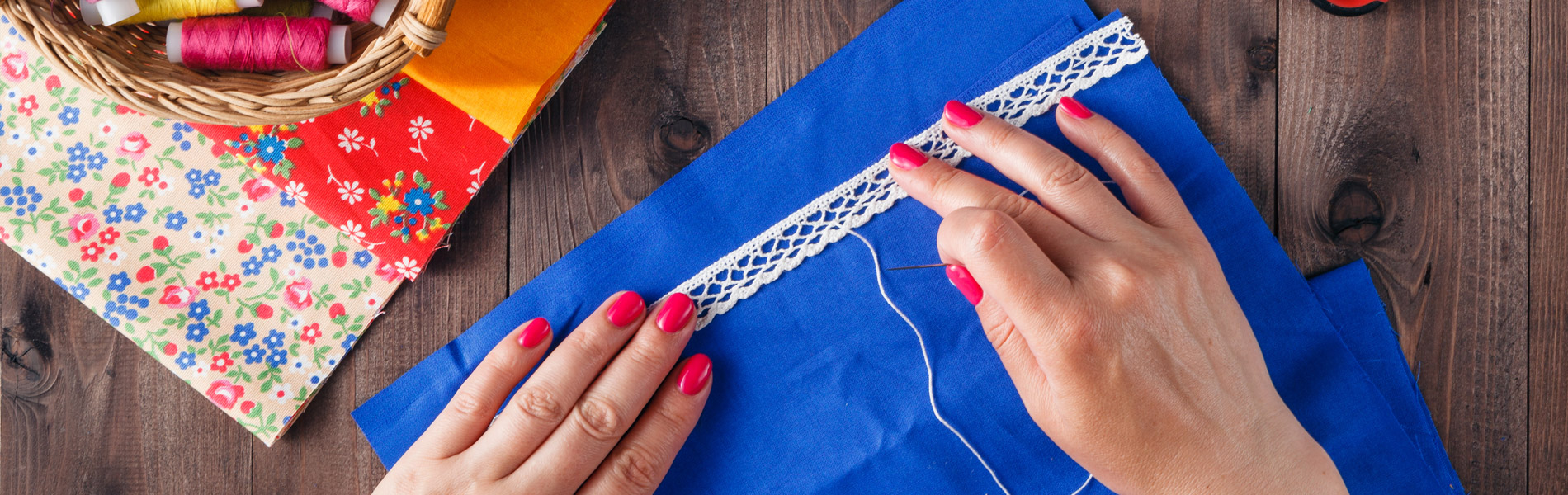
My back panel is 43 inches wide by 36 inches long. And my back panel, I've already attached the lace to the sides in the lower edge. And we're mitering that lace around the corner and I'll show you how to do that when we get there. So I'm gonna set that panel aside and my front panel, I'm going to attach my lace. So starting at the upper edge and starting on with the right side, if you have a fabric that has a right and wrong side.
this one doesn't really. So we're aligning the lace with the right side of the fabric, the header of the lace with the edge of the fabric. And when I stitch right along that header, I'm going to stitch kind of, not in the center of the header, but kind of more toward the lace. That's gonna give me my quarter-inch seam allowance or hem allowance, rather, to hem the edges of the side panel and I'm aligning the lace just inside the raw edge. I'm not going to pin it all the way around.
Normally I love using pins, but for this I'm just going to start and I'm going to keep aligning this lace with my edge as I stitch down. So I'm stitching kind of nice and slow because I don't have pins. I wanna make sure everything remains aligned where I want it to be. If you are using a nice lightweight fabric you're gonna double-check your tension, because if you're using a really lightweight fabric, you might have to increase your needle tension slightly to allow those threads to wrap around that really thin fabric and lay nice and flat and tight against the fabric and create a good stitch. Now we're coming toward a corner so, you're gonna miter this corner, as you would miter anything.
I'm using a quarter-inch seam allowance, so I'm going to end my stitching a quarter inch from the next edge I'm gonna take that out from under the foot, and push that lace up so that the lace, the header of the lace aligns with the next raw edge that I'm mitering and so we get a nice 45 degree angle here on the fold and then I'm going to fold it down so that the header aligns with the raw edge that I wanna stitch it onto and then that creates another fold right up here, along that edge that I just stitched. I need to throw a pin right in there. And then when I start stitching again, I'm going to start stitching right at that upper edge, right at that fold. You have a lot of trim options to finish these edges off. You can use any type of thin ribbon, those beaded piping type piping that they make that's kind of like beaded crystals would be really pretty for something like this, where you're going for just kind of like a lightweight airy, yet still elegant silhouette.
I'm gonna miter this corner, same way, stitching up to our seam allowance distance from the next edge. Folding the lace up and then back down and the edges of this skirt are kind of ravely. So if I were to do this again, I would cut out my rectangles using pinking shears and that helps control fraying and then when I turn this lace under in top stitch, it's going to be nice and finished on the wrong side. And just cutting the rectangles out using pinking shears, just adds another layer of protection against raveling and fraying. So this is my final edge that I'm finishing with this lace.
This kind of edge finish is also good for if you're you don't quite have enough fabric for a double fold hem or you accidentally cut your rectangle too small And you want the type of edge finish that will use the least amount of fabric, this is a good option. Right, at this upper edge, I'm going to backstitch and then cut the excess trim off And I wanna show you those corners. So when that's folded to the wrong side, it just miters so nicely around that corner. So I'm going to press this. Press the lace down so that the seam allowances are pointing toward the wrong side.
Then we're going to top stitch to hold down the seam allowances, and also to finish these edges and prevent any further raveling. And when I top stitch, I like to use a matching thread so that it is fairly invisible, but that is also your choice. When you're sewing with a really lightweight fabric like this one, you may find that your seams are just maybe not strong, or if you've had to unpick a seam, if the needle leaves enormous holes in your fabric, you may want to size down your needle, go to a slightly smaller size needle, which will leave smaller holes in fabric, which is good for something lightweight and delicate like this. All right, so there, my seam allowances are pressed under. Now let's top stitch.
And when we top stitch, we don't have a whole lot of seam loans under here, just a quarter inch. So when we're top stitching, we want to make sure we top stitch only about an eighth of an inch away from the seam, so we make sure we catch that seam allowance on the under side. And check your tension. That looks good. We're gonna pin it around this mitered corner.
Making sure that seam allowance is pressed up. And pivot again. There you go. I'm gonna do the same thing to the back panel so that our edges, and I'll give this another press, and all of those little wrinkles will come right out like magic. So my edges are still a little bit fraying on the wrong side, but since we top stitched that it's not going to fray much more than that.
Now to attach these panels together, I like to have the back panel lap over the front panel. So making sure that the right sides are facing up on both panels, we're going to lap these by about two inches, two inches from seam to seam. Align the upper edges lap by two inches and pin and then we're going to face this upper edge. So we're going to baste, so our basting stitch, we wanna increase the stitch length all the way because we're going to be pulling up on the threads to gather this upper edge so that it's easier to insert into our waistband. Basting this upper edge together also helps just keep it in place.
And a lot of times when you attach an elastic waistband, you don't baste the upper edge and you just stretch the elastic to match the upper edge that you're attaching it to, but with this one, we have so much extra that we're trying to gather in, it'd be really hard to really hard to stretch the elastic that far and it may even damage your elastic to try and stretch it so far. So we are basting and gathering to help fit all of this circumference into our elastic waistband. Make sure everything's laying flat as you come to beginning or the place where you started basting. We've long thread tails. And then what we're going to do is we're going to quarter mark the upper edge here and we do that by folding it in half.
And you can match the join here, match those overlaps to get your center front and center back. And then, fold, unfold and refold to match your center marks together to get your side marks. And when we get our elastic waistband stitched together, we're going to quarter mark that as well. So let's get that elastic. We talked about it, but then I didn't do it.
So I mentioned to cut your elastic waistband to your waist measurement plus one inch. And this is very kind of subjective as well, depends on your preference. You can cut your elastic to your waistband length and then when we lap these edges together, we're going to lap them an inch and then stitch the edges. So if you cut your waistband to your waist measurement and then lap it an inch, you get an inch of negative ease. And that means it's just, it's going to be tighter around your waist.
So if you want your skirt to be tighter on you, cut it to your waist measurement or slightly shy of your waist measurement. And then when you lap it, it's going to get even smaller yet and sit really tightly to your body. Some people don't like that. They don't want their skirts to be super tight or their waistbands to be really tight. So to join this elastic, you can match the raw edges and stitch a seam, like a regular seam, using a half inch seam allowance and that will give you your one inch negative ease, but I like doing it this way.
I just feel like it gives you less bulk. I'm just lapping those edges one on top of the other and I'm going to zigzag stitch over this edge and that edge. Each raw edge gets a zigzag. And I have purple thread in my needle and bobbin right now. And I really don't mind that look on the right side of my waistband.
I think it's kind of cute. So there's one edge and then I'm gonna zigzag stitch this edge as well. And instead of back stitching, I'm going to tie off my threads just because the fewer times my needle can go through my elastic, the better it is for my elastic. So I'm going to tie these. And just tying it right over top of the edge.
You can add a little fray check to the knot. If you would like, this is quite the stress point having this elastic stretching around your body to pull your skirt on and off. The seam does get a bit of wear. Oops, there we go. Now to quarter mark this elastic, fold that, fold your back right in half, matching those zigzag seams, that's your center back.
Yeah, I'm not, I don't really need to mark that. I can tell that that is my center back, but I wanna mark my center front and then I'm going to match center front and center back to get my side marks. Now to attach the upper edge of my skirt, to my waistband, I'm going to, I don't need to gather up my upper edge of my skirt so much so that it matches my waistband. Just enough that I'm not killing my elastic by stretching it so far to match this huge circumference of my upper edge. So once we start getting gathers in this skirt, we're going to get the elastic waistband in.
But we're gonna gather from both sides. And we wanna distribute these gathers around, all the way around the circumference of the skirt. So let's start getting our elastic on here and we're gonna match our quarter marks and see how much more we need to gather it up to get it to start matching. So we've got the right side of the skirt ups. We wanna get the right side of the elastic matching the right side of the skirt And we're just matching these quarter marks.
Okay so we have our quarter marks matched and we want to gather the skirt upper edge so that it's sort of evenly distributed, but if you did multiply your front panel width by only 1 1/2 and you multiplied your back panel width by two, that means you want more gathers in the back. So once we get this sort of evenly distributed, then we can distribute more to the back if we want more in the back. But the point of quarter marking and matching the quarter marks is to make sure we have our weight mostly distributed where we want it. So if you have clumps of gathers here or there, just kind of even those out. Now, when we stitch this upper edge, we're going to be using our zigzag stitch so that we will have some stretch in the seam.
So we need that stretch so that we can get our skirt on over the hips. So we need a little stretch in the seam and we've got these gathers in the upper edge so that the upper edge will expand with the seam and then the elastic and the zigzag stitch will bring it back in to sit nicely at your waist. I've got a lot of threads going on here. So I'm going to do a little housekeeping. When we start stitching, I like to start at the center back just because it's a good place to start.
And we're using our zigzag stitch and I actually, I wanna have the skirt fabric facing up so that I can see what's going on with my gathers and my ruffles. And then once I get the needle down, take a couple of stitches. Now, if there's any extra fabric that needs to be, if you haven't gathered your fabric enough to the length of the elastic, this is where you would hold on to that next quarter mark and stretch. But I gathered my fabric so that the edges were matching. So I'm just going to stitch.
I wanna make sure my zigzag stitch covers this. I'm actually gonna make my zigzag a little bit wider so I can cover the raw edges. So I'm kind of finishing off my raw edges As I am stitching my elastic to my skirt. So as it's coming out the back, you can see it's going to have stretch to it, And we're going to take the basting thread out, of course, once we get this stitched on. And I like to have my right needle swing swing off of the edge of the elastic.
I mentioned before, the fewer times a needle can go through the elastic, the better. So we're having that right needle swing swing off the edge of the elastic and if you do need to pull, stretch that elastic to match your raw edges, you wanna put even pressure behind the needle and in front of the needle. So you're not just pulling in front of the needle because that would pull your fabric and you'd have a hard time getting that fabric under the needle. And then we come back to where our seam began. So you can backstitch, you can tie off your threads and then remove that, I wanna remove the basting stitches from your skirt, however you wanna do that.
So once you get that all pulled out and your waistband is attached and then you have your panels that split in the front. So this project is just a fun, easy way to make a cute skirt and a maxi length, but the details of it just change things up and give it a different look and it's really easy and quick to do, but you get a big look from it. So I hope you enjoy.
I agree with most of these comments - we have no idea what the split panel skirt looks like! I Googled it and got so many variations that I really have no idea what Nicki made. These comments, by the way, are almost 5 years old. Has no one looked at these comments? Hello!
I love her videos they have taught me so much! My only suggestion is showing an after product even if it is just a photograph in the description and may fast forwarding through long stitches. I really enjoy her videos!
Agree that I have zero idea what she actually made. A "split panel" skirt sounds like, after the made it, a skirt with long slits? But I can't be certain...
I sure would like to know what a split panel skirt looks like. Also, this is my first video I am watching and I would suggest you have an example written on a white board or something that you can refer to as you go through the calculations.
Aren’t you going to show us the finished project? I would love to see what the final result was.