
Tips for Working with Terry Fabrics
Jessica GiardinoTerry cloth is a nice, soft fabric often used to make towels and robes. While some may find this fabric tricky to work with, Jessica Giardino shows you how easy it can be and shares some helpful tips along the way. Then she shows you how to use the fabric and make a fun spa wrap.
Terry Fabric
Before beginning a project with terry cloth, it is important to know that there are different kinds of terry fabrics. Jessica shows both a towel terry and a French terry and explains some of the main differences between the two. These include the fact that one of them is a woven fabric while one is a knit, meaning that one can have a small amount of stretch to it.
She also explains how the terry fabrics are constructed and why some terry fabrics have loops on the right side and why some do not. Having loops on a terry fabric is very helpful if making a towel or other bath accessory, as the longer the loops, the more absorbent the fabric is.
Sewing Terry Cloth
Working with and sewing terry fabrics doesn’t have to be difficult. Jessica shares several tips and tools to use when making a sewing project from either French or towel terry. A lint roller can be helpful when cleaning up the lint that is created from cutting the cloth, and fabric clips rather than pins can help when trying to hold together several layers. She also recommends using a heavier weight needle when sewing with terry fabric. Jessica then shows you how to use terry fabric to make a fun and stylish spa wrap.
The wrap features a cute towel terry pocket and ribbon straps. The wrap shown in the tutorial is a smaller size meant for a child; however, it can easily be made in a larger adult size as well.
Share tips, start a discussion or ask other students a question. If you have a question for an expert, please click here.
Already a member?
4 Responses to “Tips for Working with Terry Fabrics”
Working with terrycloth can be a little overwhelming, some people see it as a challenge, but I'm here to tell you that with a few pro tips, it actually easy. I'll show you how to work with terrycloth and we'll make a delightful spa-wrap. Now you're gonna know terrycloth, mostly, as your washcloths, your towels, et cetera, the things you use around your house. So I have a washcloth here. Terrycloth actually comes in two different forms, there's towel terry, which is what you use to make towels out of, and then there's French terry, which is generally used for sportswear and things along those lines.
The main differences is that towel terry is woven, whereas French terry is a knit. So French terry is gonna have some stretch to it, as you can see, whereas towel terry isn't gonna move at all, it's just not going anywhere. The defining characteristic of terrycloth is that it is made with loops. So when as it's woven, they poke little loops up of the thread as it's going through. And those loops are actually what absorbs all the moisture.
The longer the loops on the terrycloth the more absorbent it is. So as you're working with terrycloth, bear that in mind. You also have a nap on terrycloth. So when you move your hand across it, it will look differently, in one way it might feel smooth and the other will feel rough. So when you're cutting out your pieces, make sure that you have them all going the same direction so that the nap is the same on each piece, and it won't look strange, unless that's what you're going for, you want some to look dark and some to look light.
Another thing to bear in mind is that French terry tends to have a right and a wrong side, whereas towel terry has loops on both sides. Then, again, it just depends on the fabric. You could find a towel, terry, that doesn't, it just it depends on how it was woven. In general towel terry, we'll have cotton in it. So this towel terry is 100% cotton.
It can come in a variety of fiber contents. So just make sure you check what it is as you're buying it. French terry, to put the stretch into it, it always has, usually, some polyester and some Lycra in it. It might be 100% polyester, which is what this is. When you buy it, be sure to mark down what the fiber content is, so that you know how to press it and wash it.
And before you use your terrycloth, you want to wash it at the temperature that you intend to use the fabric, as later on down the road, with the life of this thing you're sewing. French terrycloth is actually warp-woven, which means it should be easier to sew and it shouldn't run as easily. So you won't catch a run of it and make, all of a sudden, a whole line of the knit pull off, which is nice. Though, towel terry tends to be more absorbent. So when you're deciding which of the two types to create your project out of, you just wanna bear all those things in mind.
When it comes to pressing your fabric, remember to follow the fiber content indication. So this is polyester here, so I'm not going to press it as hot as I would my cotton. I find that steam really does help when working with terrycloth, it might make the terrycloth slightly darker because it's absorbing some of that liquid, but it's really helpful to get your seams, or your steam allowances, ironed up as you want. Now, speaking of seams, terrycloth will continue to unravel, towel terry specifically. French terry, because it's nit, will not.
But towel terry will continue to unravel. And all these little loops down here are just gonna keep showing up and popping off as you work, as you wear it, as you use it. So you need to make sure that your seams are encased or finished with a surger or an overcast stitch on your sewing machine. That way these will stop falling off wherever you go. Very, very good utensil to have as you're working with terrycloth is a lint roller, and they're pretty easy.
As you can see this, one's been picking up some little fluffs, wherever you go. When you're cutting terry, those loops are just gonna cut off with it and they're gonna go everywhere. So make sure your lint roller is around. Now, when you cut your terry, I don't recommend cutting more than one layer at a time, unless you have found some very, very thin lightweight terrycloth. And that's just because, as it is so bulky and it has a nap, when you're folding and cutting two at a time, it might be very difficult to get through all those layers.
So try to lay it flat and cut it that way, especially with the French terry, because it is a knit, you wanna have it laid out flat so that it's easier to get all your pieces correct. Let's see. Oh, you'll find that when you have a very bulky seam, you may not actually be able to pin it, as you would like. So you're gonna wanna get some fabric clips. These ones happened to be made by Clover, but a variety of companies make them.
These ones are small, you might want larger ones, so just shop around, I'm sure you can find them. Hair clips would work well in addition to these. And then you also want to make sure you install, on your machine, a thicker needle, like a denim needle or a... Anything like 90 or above would be ideal. Okay, so let's talk about our spot-wrap.
This spot-wrap, as you can see is kind of small, it's for a child, but you can make yours to fit you perfectly. So the thing you're gonna need to do is take your measurements. All right, so with your measuring tape you wanna measure right where you want the top of the spa-wrap to land. So generally, the top of your armpit or your high bust measurement. And you're gonna go right along here and measure all the way around.
Take that number, add three to it, for seam allowances and a little bit of wiggle room, and then you're gonna have your overlap. So where the Velcro meets up, this is our overlap. This overlap is seven inches. Your overlap should be between six and eight inches, If you're very, very concerned about it gaping open, you can go even wider, but in general, I recommend a maximum of eight, just for purposes of how much Velcro to buy. So this overlap is gonna be seven inches.
So it would be your measurement plus three inches plus seven, so in total, plus 10. If you have a wider overlap, then that's what you're gonna wanna add. The next measurement you need to do is to determine how long you want it to be. So you're gonna measure from where you started, up here, sort of in your armpit area, or wherever you decided to start. Maybe you're making this for a gentleman friend and it's going to just be around the waist.
So start then at the waist. And this would be a good time to have a friend over to help you measure, 'cause you're gonna let it fall as low as you want it to be, and then market. So, generally, that would be maybe knee-length or below knee-length. I don't recommend going floor-length because all that will really be holding it up is some elastic and maybe some straps. So if you have the straps they will hold it on your shoulder, so it might work out.
But floor-length terrycloth is gonna be very heavy, so bear that in mind, so you're gonna mark that. Once you have that measurement, you need to add an inch for the hem and three inches for the upper portion. Now that three inches is based on using one and a quarter inch elastic. If you decide to use wider elastic, you need basically double that amount plus a seam allowance. Okay, we will take one more measurement towards the end, which is for the straps, if you're using them, they are definitely optional, but for now you're done taking your measurement.
So let's set this to the side. And once you have those measurements, you know how much fabric to buy. I've found that, in general, terrycloth does not shrink that much, but if it's... I mean, this is a hundred percent cotton and I did a shrink test with hot water and dried it on hot and it did not really shrink at all. So just consider that it probably won't drink all that much but buy a little extra, just to be safe.
So this is cut the measurement around the bust plus seven inches plus three inches, and then the length plus an inch for the hem, plus three inches for the upper portion. And then all I did on the sides here is I use this handy-dandy pressing tool. You can see here it's got all these different markings on it. And I folded it over half an inch and I pressed it and then I followed it another half inch and pressed it. And that means that that edge is completely enclosed.
And then I just stitched right along the edge, or right down the middle. And again, here I did the same on the other side. The bottom present, the hem edge is not, I haven't touched that yet, so you don't have to worry about that. Now, your upper edge, fold that over half an inch, as you can see, and then just stitch right along the edge there. And when you were stitching you want to make sure that you're lengthening your stitch-length.
So instead of going at the normal 2.5, you wanna move up to say 3.3 to 3.5 millimeters. All right, once you're at this point, you've got these edges ready to rock and you're gonna pull out your elastic. So my elastic is this non-roll, one and a quarter inch wide Dritz elastic. And you're also gonna need some pins. Oop, there we are.
And you wanna take whatever your overlap's gonna be. So on mine, my overlap is seven inches. So I'll measure from the very edge here to seven inches. And I will just insert a pin right there, so that I know exactly where that is indented. Do the same on the other side.
And you could use... Oop, that's not seven inches. You could use a removable fabric marker but I find that it gets lost in the loops of the terry. You really do not wanna use tailor's chalk because that's gonna get in there and when you press things, it's gonna become permanent and it'll just be a nightmare to get out. All right, so then I'm gonna use some of my elastic.
Now, how much elastic should you use? Well, you don't wanna just have elastic that's the same length as this 'cause it won't stretch at all. This is for a child, so I'm not super worried about it staying up because there's going to be straps and little children's bodies or sort of cylinders. Instead of doing a lot taken out, I'm just gonna do four inches off. So I'm gonna cut my elastic so that I make sure it's down here, and then four inches shy, which will give me enough gathering space that it'll hold tightly to her, but it won't be too tight and also she'll have the straps to help.
Now, if you're not a child and you're making this for yourself, you need to subtract probably a bit more, especially if you're not using straps. Don't subtract more than a third of the measurement between the two overlap sections, because then, the elastic will not feel very good when you're wearing it. In fact, if you know how long your overlap will be, mark off the seven or eight or however many inches you're using on the front of you and pull the elastic around at the measurement you think you wanted at and just hold it there and feel if it feels comfortable. If it feels like it's stretching too much or biting you... I mean, it will be wrapped in towels, so it won't bite you too much, but consider how it feels.
If it feels really, really tight, you might want a little more elastic. So before you cut it, give that a go. All right, so here I am. I'm just gonna cut this at four inches less and the first thing we're gonna do is actually install our elastic. Now this is one instance where I am going to use pins instead of clips, just because I wanna make sure I get my elastic in the exact right spot.
So I align up my elastic, just one end down here, with my overlap marking pin and I insert a pin to hold it. Now I'm not gonna pin the other end just yet. For stitching this elastic in, you can use a variety of methods, you could do zigzag stitch or you could go with the box method, which is what I'm gonna do. And because mine is for a wee child, I'm not gonna worry about making my box method. You could make a box that say a half inch wide, and that would be very secure, but I just gonna do a small box.
So you put your elastic right here, make sure that the upper edge of your elastic meets the lower edge of the folded over portion of the towel. Okay, so we're gonna stitch down backstitch. This is all about stitching on top of your stitches and making very, very strong stitches. And I have increased my stitch length to 3.5. Okay, I got 'em down at the end.
I'm gonna lift my needle and I'm gonna push it over, just about an eighth of an inch and put my needle back down and then hit the reverse button, ooh, and quickly sew back up to the top. Put my needle down and go back down a little ways. You could make box, as I was saying, as wide as you want it to be. Okay, now I'm on the other side, I'm gonna put my needle down and sort of angle so that I'm heading across the box that I've made to make an X in the middle. But this is a tiny little box, so it's not gonna be a super duper cross or X, I guess it would be.
Okay, as one, we go to the top there, and then we head to the bottom, turn at an angle, go back and forth a few times. All right, this site is in. Oop, scissors. Okay, clip your threads, clip the edges of your elastic, if it's starting to shed. You could pink the plastic, if you were worried about it unraveling.
And now I can remove the pin marking my overlap because the elastic marks that. All right, now I'm just gonna take the other portion, the other end, make sure that it is not twisted, place it down here at this part and pin it. In place. Okay, and then we're just gonna sew the elastic one more time. And when you're sewing elastic in, the reason you reverse so many times is that the elastic stretches, and it might pop a stitch, but if you reverse...
Oop, needle down! Let's make sure we take out our pins and not so over top of them. If you reverse over it, those stitches are even more secured. And this part that you're stitching right now is not gonna show, nobody's ever gonna see it, 'cause it will be on the inside and it's in thick terrycloth. Okay, and then I do my cross, going right across there forward.
And clip, clip, clip. All right, I'm gonna take out the pin. And as you can see, there's some stitches that are deep in the pile because I'm using matching, or mostly matching thread, it actually hides itself pretty well. And there's my upper edge. So it's pulling together a little bit.
I know that when I stretch it out that it'll gather up nicely. All right, so next we wanna put our elastic on, or our hook and loop tape, the Velcro. I'm using half inch wide Velcro and you can see I've cut the rough side to be slightly shorter, well, about an inch and a half shorter, than the soft side. Now, the reason for this is that I like to have put the soft side of the hook-and-loop tape on the exterior of the towel so that when you bump up against anything, or if you touch it with your arm, it's not gonna scratch you. And then I put this on the interior of the towel wrap so that it just matches up.
Now, the reason it's shorter is that then if you need to move it out a little bit, you don't have that rough side of the hook-and-loop tape touching your skin. So, with that in mind, we're going to fold down. And you can put whichever side on whichever side you want. If you wanna put your scratchy side of your hook-and-loop tape on the left, then go ahead and do that, it just depends on how you overlap it. So the way mine overlaps is the right side over the left.
So I'm gonna make this as smooth as I can up here, matching my elastic to that upper edge. And I'm going to fold it over. This is where my clips come in handy because now we have multiple layers. And over here on this edge, it's like five or more layers, so we're gonna just clip this instead of even trying to pin it. And you wanna make sure that the elastic isn't getting underneath the stitches and that it's kind of up in the top right here where you can feel it.
So go ahead and clip there. Okay, so on this side, I know this is the interior of my wrap, put your Velcro in place, right here. And you do need to pin your Velcro, but you wanna pin it halfway between the two points and not near this edge where you have it folded over several times and stitched. So go ahead and put your pin down, poke through just one layer. You can see it's not through the bottom layer here, it's just through the top layer, and then pin in place.
So that's where we're gonna put the Velcro on the the scratchy side. And you can pin that however you want. You know, a few extra pins can't hurt. And I would clip this if I could, but my pins are... Or my clips are very small so...
Okay, then we're gonna do a similar thing down on this end. So we're gonna pull. I'm gonna release this clip so that I can pull my elastic nice and smooth and fold it over again. And now, with that in mind, with the fact that I know that my soft Velcro needs to go on the outside, I'm actually gonna fold to the front so that I can see exactly where it needs to go. And I'm just gonna feel, I can feel right here, that's the edge of the folded over towel portion, and this is obviously the folded over upper portion.
So I will take some pins and scoot this away from that stitch line so that there's at least roughly a quarter of an inch between the edge of my Velcro here and that stitch line where I did the side seam. Okay, and again, you don't wanna pin through all the layers, you just wanna pin through one layer, so you poke down and find it and you can see I just went through one layer there. All right, so can pin there as well, if it's agreeable. Definitely pin as much as you want. Okay, and so my next little sample will show you what that looks like once you've stitched it.
So here we are. I stitched the Velcro on nice and carefully. You just wanna stitch as much as you can on this side of the Velcro as opposed to deep into the pile of the Velcro, and that's true for both the hooks and the loops. Whoop, there we go. So you can see there, stitch that right on.
Then once I finished stitching that in place I went ahead and folded the entire upper edge over the elastic and I made it as smooth as I could and I stitched down until it was totally gathered up at the end and I reversed stitched and forward stitched and then cut my threads and removed it from the machine. And then I just pulled down all of that extra fabric to this end, and so that it was nice and smooth here, and then I stitched down to meet where I had stopped stitching prior. So that's how you finish this upper edge, is by doing that. So fold it over, clip it and stitch down until it's super bubbled. You don't wanna sew over too many gathers, you want it to be able to move along the elastic.
And make sure you don't catch the elastic as you're sewing. That's why you wanted to keep it so that the elastic isn't touching that folded over edge. Okay, so then you're ready to your straps on, if you're going to, and your pockets. So, first, let's do the straps. Put your spa-wrap on and match up your Velcro as such and measure.
As you can see, it's getting everywhere, so we should use our lint roller. And then measure where you want your straps to be. So in general, it would be where you put a bra strap or a swimming suit, strap, whatever you want. But measure where you want your straps to be and mark that with a pin on the spa-wrap. So I did that and then I pinned my ribbon right in place.
You don't have to use ribbon, you could make straps out of terrycloth if you want, it's up to you. So I have that here, as you can see. So all you have to do now is stitch just along that edge and you're lining it up so that your stitches end up right slightly above or preferably in the ditch where you had those other stitches, so that they won't show whatsoever on the front. and continue using matching thread, that's the real trick here. If you have a walking foot that can help...
I have this machine that uses this little back lever here that pulls them fabric through for me instead of a walking foot. So you're gonna put your needle down. Again, use a length in stitch, so 3.5, 3.3, whatever you prefer, and then just stitch carefully across and backwards and forwards at the end. Whoop, ooh, see, it's pretty bulky, might get stuck in your machine. We're gonna clip our threads, preferably all, all of the threads will be clipped.
There we go. And as you can see, it doesn't even show really because all those terrycloth loops come up. And if you are worried about it showing, just scratched a little and more terrycloth loops will come up. Another note, once you folded that over on the previous step, you'll have this opened end. Now you can cut this at an angle.
And then I just stitched right along where this edge meets to hold it up. But if it bothers you that it's open that much, just slip-stitch that shot with matching thread and no one will ever see it. Okay, so this strap is on. Now I wanna put it towards the back. To keep straps from fighting off your shoulders, you want to angle them so that on the front they look straight, but on the back, they come in at an angle.
So I've marked right, where they should be with some pins. Make sure your strap is not twisted and then just center your strap over that pin and stitch just as we did across there, as we did on this one. And then you will repeat that to finish your other strap. Now it's time to make your pocket. So your pocket doesn't have to be a different color, you can make your pocket whatever you want it to be.
In general, I would recommend using a matching thread on your pocket. And I have my pink thread in, so I'm just gonna go ahead and sew it with that. But definitely if you're doing a different color, poke it, make sure that it is a similar color thread in. And so put your fabric right sides together. And to cut this pocket out, all I did was I cut a six by six inch, maybe six by five and a half inch square.
Cut two of those and then I just rounded the corners with a jar that I had, to trace on there. Or you can just fold one and half and cut round, and then make sure that it matches on the second one. Okay, so to stitch our pocket, we're just going to use whatever seam allowance you prefer. I'm gonna do half... Well more like third inch seam allowances.
Generally, I think quarter might be too thin but half inch might be too thick, that would make our seems really bulky, so I'm doing about a third. When I get to the end, because this is going to be a bulky material, instead of stopping and pivoting and going exactly at that right angle, I'm gonna stop and I'm gonna take a few stitches. So if the pocket is like so, it'll go at an angle across and I'll show you that when we finished, but take one, two, and then turn and you're ready to continue. You're just gonna stitch all the way around. Be sure to leave an opening, and pivot with your rounded corners.
And of course you don't have to do rounded corners. And you can do any shape you like. I just made kind of a normal patch pocket shape, but you could make a flower or heart. You could make it out of a different material all together. I mean, this project is very, very personalizable, if that's a word, I don't think it is.
Personalizable? I think we'll pretend it is. Okay, so I stitched all the way around. So personalize your project as you see fit. Add ruffles, add more trims, whatever you wanna do.
Okay, so we've stitched all the way around. And you can see right here on this corner... Well, it's hard to see, but, instead of going up and then turning, there's two stitches at an angle before I go all the way down. And clip off that corner. Like, so, it's very thick.
And then you might actually want to clip and notch your roundedness, down here, or just grade your seams so that it turns nicely. Okay, whoop, there you go, shove through, pop out the corner and push it down. And I think you could add a variety of raffles, you could add some accoutrements to your pocket here. So once it's right side out, you wanna just run your finger along all the seams in there. And then puts your raw edges in so that it matches up and give it a press.
And once you give it a press, it should stay. But if it doesn't, employ your clips, throw some clips on there and that'll hold it in place. And then you're ready to basically top stitch it onto your your little spa-wrap here. So just think about where your hand would be. Put your spa-wrap on with your straps and put your hand down.
Wherever your hand is you want it maybe just a little bit higher. So if your hands way down here put it maybe right about here so that you can reach in easily. And then mark on there with a pin or marker, or whatever you're using, where it should go. So mine is very near my side scene. And then I have top stitch to the round.
And a pro tip on that one is use your blue thread on your upper thread on the machine and your pink thread and in your bobbin, and no one will ever see the stitches. I mean, you can see that line there but it's not a bright blue line, on the back here. And that's it, you've got that on. Make sure you measured your straps when you put them on. So you'd measure from the front where your upper part is to the back, a friend would be very helpful at that point, and then you put your straps on.
But again, straps are not necessary, the elastic and the hook-and-loop tape should hold this up for you. So enjoy this spa-wrap and enjoy using your special terrycloth skills. I'm pretty sure you can master it now.
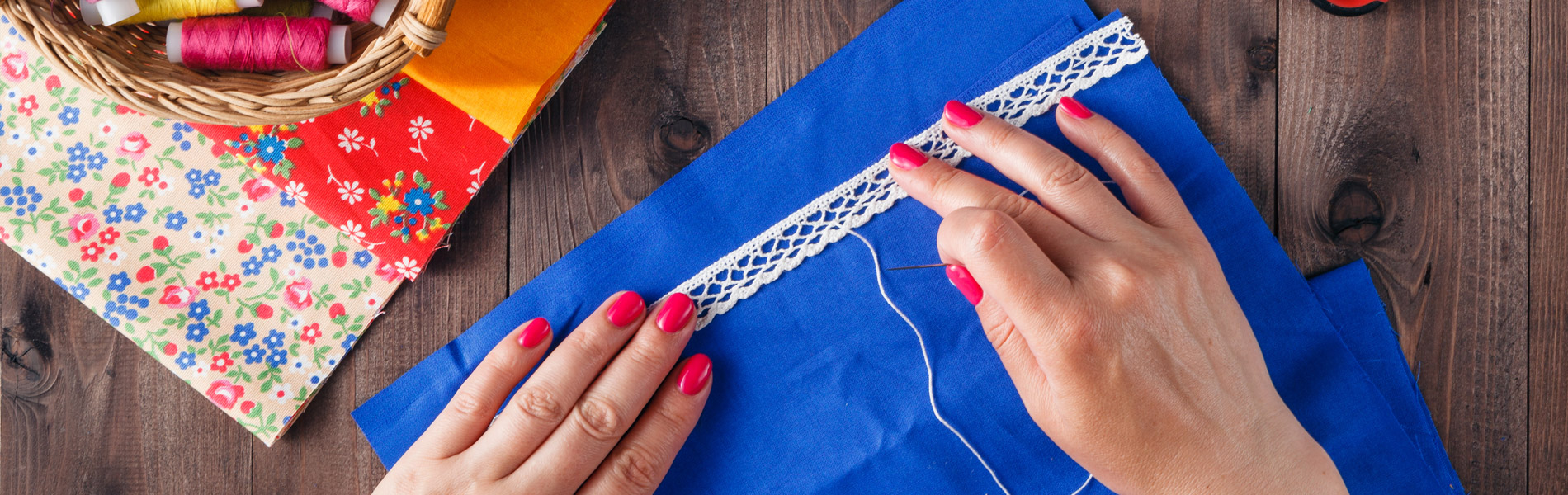
When making a lined patch pocket, it works better if you sew about 1 inch on both sides of all corners.This way you can place the opening entirely at the straight section of the bottom or one of the sides,
This was a wonderful tutorial. Thank you.
Does sewing with terry cloth require a walking foot?
What if one has extra wide hips or large booty?